Paper trading is a method of practicing financial trading without using real money. Instead of placing actual trades, traders use a simulated account to buy and sell stocks, forex, cryptocurrencies, or other financial instruments. The purpose is to learn how markets and trading platforms work while testing strategies without directly risking real capital.
Paper trading is commonly used by beginners who are learning the basics of trading. It can also be useful for experienced traders who want to test a new strategy before applying it to a live account. Although paper trading can provide valuable practice, simulated results do not always match real-world trading because factors such as emotions, liquidity, and execution can be different.
How Does Paper Trading Work?
Paper trading typically takes place through a demo or simulated trading account. The platform provides virtual funds that can be used to place trades based on real or delayed market prices, depending on the service.
For example, a trader may receive $100,000 in virtual funds and decide to purchase shares of a company. If the simulated trade is opened at $100 per share and the price later rises to $110, the platform may show a $10-per-share virtual gain. If the price falls, the account will show a simulated loss.
Traders can usually practice different order types, including market orders, limit orders, and stop orders. They can also experiment with different strategies without putting their actual savings at risk.
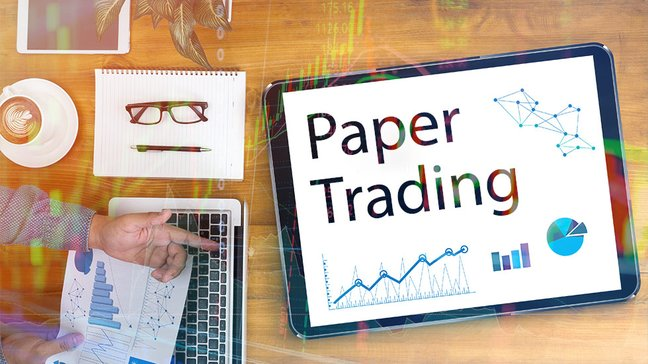
The exact features of paper trading vary between platforms. Some provide real-time market data, while others may use delayed prices. Traders should understand these differences when evaluating their results.
Benefits of Paper Trading
One major benefit of paper trading is that it allows beginners to become familiar with a trading platform. New traders can learn how to read charts, place orders, monitor positions, and manage trades before using real money.
Paper trading can also be useful for testing strategies. A trader might want to experiment with moving averages, support and resistance, breakout strategies, or other technical-analysis methods. Instead of immediately risking capital, they can observe how the strategy performs under simulated market conditions.
Another advantage is that traders can practice risk management. They can experiment with position sizes, stop-loss levels, and entry and exit rules. Keeping a trading journal during this process can make the practice more structured.
Paper trading can also help traders identify technical mistakes. For example, someone may discover that they are entering trades too frequently or using positions that are too large for their planned risk level.
Paper Trading vs Real Trading
The biggest difference between paper trading and real trading is that paper trading does not involve actual financial losses or gains. This makes it useful for learning, but it also creates an important limitation.
When real money is involved, emotions such as fear, excitement, hesitation, and frustration can influence decision-making. A trader may follow a strategy perfectly in a simulated account but behave differently after experiencing a real loss.
Execution can also differ. In live markets, orders may experience slippage, meaning the actual execution price can differ from the expected price. Liquidity, spreads, commissions, and market conditions can also affect real trading results.
Therefore, success in a paper-trading account should not be considered proof that the same strategy will generate similar results with real money.
How Beginners Can Use Paper Trading
Beginners can start by selecting a reliable platform that offers a simulated trading environment. They should choose a virtual account size that is reasonably similar to the amount they might eventually consider trading with.
Instead of making random trades, it is better to create a simple trading plan. This plan can include the markets being followed, entry conditions, exit rules, position size, and risk-management approach.
Traders should record every simulated trade in a journal. Important details can include the reason for entering, entry price, stop-loss level, target price, exit price, and final result.
After completing a reasonable number of practice trades, traders can review the results and identify recurring mistakes. They should also remember that market conditions change, so a strategy that works in one environment may perform differently in another.
Paper trading is an effective educational tool for understanding the basics of trading and testing ideas without immediately risking real capital. However, it cannot completely reproduce the psychological and execution challenges of live trading. Beginners should use it as a learning and practice tool rather than treating simulated profits as guaranteed future results.